Tender, Not Just Huge: Judging the Chicken in Your Parmi

Brady Stroud
—12 October 2026
Learn how to judge the chicken beneath your parmi toppings, from thickness and tenderness to the limits of what appearance can tell you.
A big schnitzel can hide an ordinary feed
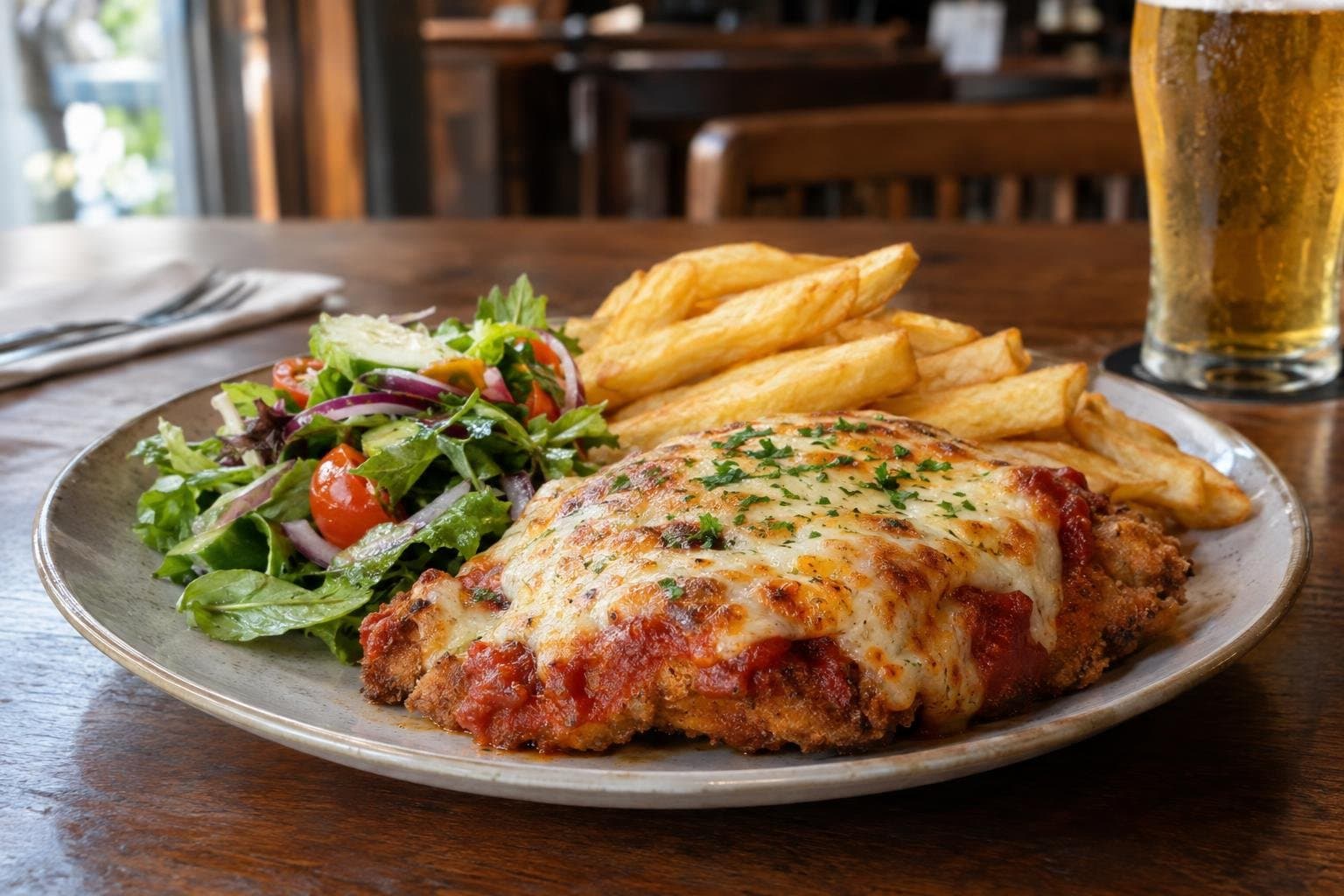
I like a generous parmi. But a piece of chicken hanging over the plate only tells me how much space it occupies. It doesn’t tell me whether the middle is juicy, the edges are dry or every mouthful needs a gulp of water to get it down.
The chicken deserves a bit of attention before the cheese steals the show. It’s the largest part of most parmis, yet it’s surprisingly easy to finish a meal remembering the toppings and barely thinking about the meat underneath.
When I reviewed Embassy Bar & Kitchen in Brisbane, I noted a nice thick piece of chicken and a thick layer of mozzarella, but not much sauce. The whole plate scored 4.6/10. That’s a useful reminder: generous chicken is a positive, not a guarantee of a good parmi.
My scores run from 0 to 10 and cover everything on the plate, including the toppings, chips and salad. Nothing off the plate earns points. But when I want to understand why a parmi falls short, the chicken itself is worth a closer look.
Thickness matters most when it’s uneven
I don’t have a preferred chicken thickness measured in millimetres. I want a piece that eats well from one end to the other.
A very thin schnitzel has little room for error during cooking. It can lose moisture quickly, especially when it needs further heat to finish the toppings. There’s also less meat in each bite to balance the crumb, sauce and cheese. Thin doesn’t automatically mean bad, but I still want to taste chicken.
A thick piece has its own challenge. If one end is a lump and the other tapers to almost nothing, getting both sections cooked nicely is harder. The narrow end can become dry while the thickest part finishes cooking.
That’s why I pay more attention to reasonably even thickness than sheer size. A broad, evenly flattened breast can be excellent. A chunky one can be excellent too. Neither gets a free pass on appearance.
For a quick comparison, I try one bite from the centre and another from an edge. A big difference in tenderness tells me more than a photo of the entire plate.
Separate tenderness from softness
Tender chicken should still feel like chicken. I want it to separate easily as I chew, with some recognisable texture rather than a dense, rubbery resistance.
Dryness is a different problem. Chicken can be easy enough to cut but still feel fibrous and thirsty in the mouth. A generous coating of sauce may make that bite more pleasant, without changing the meat underneath.
Then there’s the soft, unusually uniform texture that sometimes makes people suspect a formed chicken product. I’m cautious about calling that from one mouthful. Processing, tenderising and cooking methods can all affect texture. An even shape alone proves very little.
At South Bank Beer Garden, I specifically noted that the chicken tasted good and didn’t taste reconstructed. That plate scored 7.7/10 overall. It’s the sort of eating quality I’m looking for, though my tasting notes aren’t a supplier audit.
If knowing whether a venue uses whole chicken breast matters to you, asking is more reliable than trying to identify it through melted cheese.
Try one small bite without the toppings
I’m not suggesting dismantling dinner. One small piece from a cut edge, with most of the topping moved aside, is enough to give the chicken a fair hearing.
First, I notice whether it has flavour of its own. Then I check whether it stays pleasant as I chew. Finally, I take a normal bite with everything together.
That comparison matters. Plain chicken doesn’t need to deliver the full flavour of the finished parmi, but it shouldn’t rely on sauce to become swallowable. Equally, beautifully cooked chicken can disappear beneath an overwhelming amount of topping.
If I’m ordering somewhere unfamiliar and want to ask one useful question, it’s: “Do you use a whole chicken breast for the parmi?” That won’t promise tenderness, but it gives me a clearer answer than “Is the parmi good?”
Choose the better mouthful, not the bigger outline
I’ll happily take a slightly smaller piece of well-cooked chicken over a giant, dry one. I still expect a satisfying serve, and I still judge the complete plate. Size simply isn’t a substitute for tenderness.
Next time you order a parmi, compare the centre with an edge before making your mind up. You might find the chicken is doing more work, or getting more help from the sauce, than you realised.
Which venue has served you a parmi with chicken that stayed tender from the centre right out to the edges?